
EUROPEAN AND INTERNATIONAL FINANCE
Session : The international monetary systems,
from the Gold standard to today's world financial order
It is impossible to separate the history of the world monetary systems from the history of world trade.
And it is impossible to separate the history of world trade from the general history of the world (whatever "historical school" of the world you belong to).
A possible point to start from is Vasco de Gama's trip around Africa (1498) : from then on there was a well established sea route from Europe to the East Indies, and back. (He went around Africa, and Colombus around the World, because of the Ottomans.)
Even before Gama, Christopher (Cristobal) Columbus opened new vistas (1492), but let's wait until they came to fruition.
To understand the development of world trade, one must understand the logical sequence of the following events :
History of international monetary systems
1. Before the nineteenth centuryWhen you trade internationally - and it is not barter - how to pay ? With what ?
Commodity money (gold, metal with value...). But it is cumbersome and risky to transport.
As soon as the XIth century at the Champaign fairs, in Troyes, or in England, in Scarboro, merchants and bankers devised the letter of exchange (scriptural money). The beginning of a clearing system between bankers.
(Because the world had become a safer place, thanks to Carolus Magnus.)
Much later on, bankers invented fiduciary money : bank notes. (Money is only a sign of trust, because "value" is only a sign of possible future consumption. And what is needed is the signature of someone trustable.)
In the eighteenth century, silver and gold were both used to guarantee international settlements.
Silver swamped Spain and Europe after the "discovery" of the new world and its riches (Potosi, Argentina, Perou, Bolivia, Mexico)
It contributed to destroy the old social order (aristocrats had fixed revenues, whereas the merchant class could become rich).
It helped the advent of the enlightenment (bourgeois wanted to know where they are), as well as the development of industrialization (in the 18th century).
(It had started earlier, because of progress due to the desire to know, again.)
Which in turn helped the advent of the "century of the revolutions" : change all over the world the old social orders. (It is not finished at all.)
Which in turn created a new world order : developped countries looked for natural resources in colonies, and then looked for international markets
2. The gold standard
Adopted little by little by all rich nations in the second part of the nineteenth century
1867 : Paris conference : most participating countries accepted the gold standard
At first Britain, who was ruling the World then, did not see the need to participate, and was satisfyied with the old "bimetallism"
Germany joined the Gold standard in 1871, the US joined in 1879 (in the XIXth century the US were not a world power yet - England ruled the world (the home rule) -
they became the leading world power after WWII)
1880-1914 Gold (the metal commodity) is used by most nations as the international currency
Each national currency has a fixed exchange rates with gold
Example : one ounce of gold = $20.67
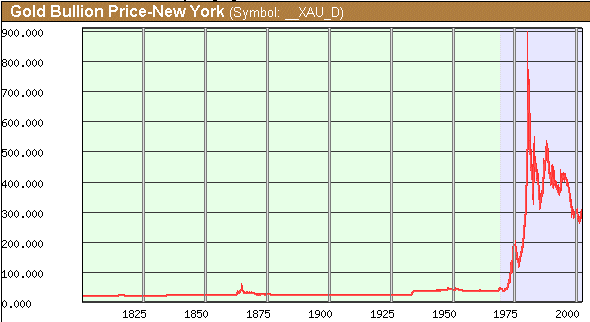
Gold, or representation of gold, flows for balance of payment adjustments
It is a symmetric system : all countries are treated the same
Automatic Balance of Payments stabilization via the "Hume mechanism"
(one of these lenifying explanations, like the "invisible hand" or the "comparative advantage" or the "theory of general equilibrium", that classical economists have accustomed us to)
The theory MV = PQ underlies the Gold standard system
One rule of the game : no sterilization (nations do not buy gold with national governement securities in order to influence the home prices)
One problem : the quantity of gold is limited, whereas the development of the world commerce requires a growing amount of international exchange currency
3a. World War One changed everything :
The Versailles treaty and Wilson's Société des Nations
The Genoa monetary conference
The United States and Great Britain went off the Gold standard
The US came back to it in 1919
UK in 1925 (Churchill pride to put back the pound at the value of before the war).
Different rates of inflation in Europe (particularly in Weimar) made it difficult to maintain fixed exchange rates
The US quit the gold standard in 1933
The Great Depression and the Smoot-Hawley Tariff Act, and its retaliation decisions, lead global trade to a slow down.
(10% instead of the world output was traded in 1938, instead of 21% in 1913)
(In 1800 the figure was 2%)
3b. The gold exchange standard
The 1920's tried to restore the gold standard, but the British pound was overvalued (stubborness of Churchill : the best english man of the day was a man of action but was not an economist, http://www.winstonchurchill.org/acty1900.htm for instance)
From 1925 to 1933, the gold exchange standard : a system close to the gold standard...
... but the US dollar and the British pound are also used to settle international imbalances
1930's depression ; floating rates (preliminary to the system post 1971).
Finally Worl War II broke up (in part as a consequence of excessive pressure on Germany after World War I - while in fact it was only a part of the causes - power of the countries holding the truth, for their economic benefit, but with no understanding of the future- , and of the US on Europe to pay back all the debts while the German debt was alleviated - by US negociators-, as well as terrific inflation, which encouraged a populist/fascist thinking in the German middle and lower classes, and also in Italy, Spain, and Portugal...)
There are still today people to think that the Gold standard is more efficient a system than the monetary policies that were devised in the second half of the 20th century to accompany a harmonious development of the world commerce.
4. 1944 Bretton Woods (Conference in July 1944, at Bretton Woods, New Hampshire)
http://www.ibiblio.org/pha/policy/1944/440722a.html
Keynes vs White : a bold new world order (with a world currency, subtly guaranteed by all of us) vs a world order dominated by the dollar, the US won.
Creation of the IMF, the IBRD and the GATT, and several secondary organisations.
The Bretton Woods system : adjustable peg
The US dollar is fixed at one ounce of gold = $35.
All currencies are "pegged" to the dollar within a 1% margin of movement
It is also a gold exchange standard system ; but an asymmetric one (with the dollar playing a central and unique role)
Two problems with the Bretton Woods system :
a) Adjustment problem
- Monetary policy not effective
- Is Marshall Lerner condition fulfilled ?
- Adjustment if fundamental disequilibrium
b) Confidence problem
- The US have to large a degree of freedom in monetary policy
- the ROW needed to follow US inflation because of parity agreements
- Gold coverage of the dollar worsened
- Dollar shortage turned into dollar abundance
In 1972, the US liquid liabilities to foreign official agencies amounted to $88 billion
- 50% held by foreign central banks
- 25% held by foreign multinational companies
- and 25% (i.e. $22 billion) in the hand of unpredictable foreign speculators, Middle East sheiks, and other unknown elements
At the same date the US reserves of gold amounted to $12 billion
(In 1960 US gold reserves were $20 billion, and foreign claims were only $16 billion...)
5. Consequence : Bretton Woods collapses ;
a new world financial order :
1969 : the IMF creates the Special Drawing Rights (some sort of "paper gold"), backed by deposits currency of members.
August 1971 : Pres. Nixon closes the gold exchange policy of the US
Pres. Nixon also devaluates the dollar by 8.5% : one ounce of gold = $38
The other major currencies, on the contrary, reevaluated by a like amount, leading to a 16% change vis à vis the dollar
In 1973, Pres. Nixon devaluates a further 10.5%.
A volatile floating rates system then prevails : called "managed floating system", or "dirty flexible rates system"
Flight into DM -> heavy German sterilization (swap of foreign currencies for government bonds ; increase in foreign currencies reserves at the Bundesbank)
(Around those years, the future European Monetary Union is incipient)
Gradual liberalisation capital transactions
6. After the fall of the Bretton Woods system :
Managed float (IMF Art. of Agr. 1978)
Adjustment /confidence/ liquidity problems solved
Formalized at the Jamaica Agreement in 1976
but in first half of the 1980's heavily fluctuating exchange rates due to US combined
- fiscal expansion (Reagonomics)
- restrictive monetary policy (Volcker)
Both drive up US interest rate and create a large capital inflow in the US
-> appreciation of the $
1982 : debt crisis in Latin America (Mexico defaulted) due to :
- oil price shocks (73 and 79)
- roll-overs, plus increase in interest rates
- syndicated loans
- LDC's : unbalanced fiscal & monetary policy
The IMF coordinated the crisis and the debt has been rescheduled
Push toward a "dollarization" of Latin America
7. The 1980's crisis management :
1985 : G5 Plaza Agreement, and
1987 : G7 Louvre Accord to bring the dollar down
8. The 1990's :
Various Developping Countries currency crises (peso and others) and the Asian crisis (1997/98)
Common characteristic : currency crisis
Credibility of the fixed Exchange Rate versus flexibility and destabilising speculation ?
1995 : The WTO replaces the GATT
9. The emergence of Europe as a united financial actor (80's and 90's)
Europe moves towards Economic and Monetary Union (EMU)
1971: early scheme for MU
1979: EMS: parity grid ("le serpent monétaire"
Less and less realignments until the 1992 currency crisis : both the UK and Italy exited the European Exchange Rate Mechanism
1991 Maastricht Treaty: foundation for EMU
US : no optimal currency area if market flexibility is insufficient to replace Exchange Rates
Flexibility loss to tackle the impact of asymmetric shocks
Europe: we go on, after three years of transition that ended 1 January 2002
The IMF : (Source : http://www.factmonster.com/ce6/history/A0808874.html )
International Monetary Fund (IMF), specialized agency of the United Nations, established in 1945. It was planned at the Bretton Woods Conference (1944), and its headquarters are in Washington, D.C. There is close collaboration between it and the International Bank for Reconstruction and Development (also the World Bank, see below). The organization, using a fund subscribed by the member nations, purchases foreign currencies on application from its members so as to discharge international indebtedness and stabilize exchange rates. The IMF currency reserve units are called Special Drawing Rights (SDRs); from 1974 to 1980 the value of SDRs was based on the currencies of 16 leading trading nations. Since 1980 it has been reevaluated every five years, based on the currencies of the five largest exporting nations (from 1990 to 2000, France, Germany, Great Britain, Japan, and the United States). To facilitate international trade and reduce inequities in exchange, the fund has limited power to set the par value of currencies. Members are provided with technical assistance in making monetary transactions. In 1995 the fund moved to increase disclosure requirements of countries borrowing money and at the same time created an emergency bailout fund for countries in financial crisis. IMF was criticized in 1998 for exacerbating the Asian financial crisis, through the fund's decision to require Asian nations to raise their interest rates to record levels. The fund is ruled by a board of governors, with one representative from each nation. The board of governors elects an executive board of some 20 representatives to conduct regular operations. There are 182 members in the IMF (1999).
The World Bank :
International Bank for Reconstruction and Development (IBRD), specialized agency of the United Nations, with headquarters at Washington, D.C.; also called the World Bank. Plans were laid at the Bretton Woods Conference (1944) for the formation of a world bank; it was formally organized in 1945, when 28 countries ratified the agreement; by 1998 there were 181 members. The bank not only makes loans to member nations, but, under government guarantee, to private investors, for the purpose of facilitating productive investment, encouraging foreign trade, and discharging burdens of international debt. All members of the bank must also belong to the International Monetary Fund. The bank is self-sustaining and has maintained a profit on its lending activities. It is controlled by a board of governors, one from each member state. Votes are allocated according to capital subscription. Ordinary affairs are conducted by 22 executive directors, five appointed by the five largest capital subscribers, the United States, Germany, Japan, Great Britain, and France, and 17 elected by the remaining members. Regional vice presidents oversee the bank's operations in five regions: Asia, Latin America and the Caribbean, East Africa, West Africa, and (in one grouping) Europe, the Middle East, and North Africa.
The bank also operates the Economic Development Institute, which offers training in economic development for officials of member countries. Closely affiliated with the bank is the International Finance Corporation (est. 1956), which invests in private enterprises without government guarantee. The bank organized the International Development Association (1960) to extend credit on easier terms, mainly to developing countries. The group of institutions is known as the World Bank Group. Criticism that the IBRD-financed projects were environmentally destructive led the bank to establish an environmental fund (1990) providing low-interest loans for developing countries. Developing nations have complained that the IBRD imposes the free-market system on them, thereby discouraging planning, nationalization, and public investment.
The Special Drawing Rights :
Special Drawing Rights
(SDRs), type of international monetary reserve currency established (1968) by the International Monetary Fund (IMF). Created in response to worries concerning the limitations of gold and dollars as the sole means of settling international accounts, SDRs are designed to augment international liquidity by supplementing the standard reserve currencies. SDRs are assigned to the accounts of IMF members in proportion to their contributions to the fund. Each participating country agrees to accept them as exchangeable for reserve currencies in the settlement of international accounts. Deficit countries can use them to purchase stronger currencies, which then can be used to pay off balance-of-payments debts. As nations adopted the current system of floating exchange rates (1973), the value of SDRs began to be set relative to a “basket” of major currencies. In 1981 the IMF reduced the basket to five currencies (the U.S. dollar, German Deutschmark, Japanese yen, French franc, and British pound); in 1999 the Deutschmark and franc were replaced by their equivalents in the euro. All IMF accounting is done in SDRs, and commercial banks accept SDR-denominated accounts. The IMF has the exclusive right of allocating SDRs; the last such allocation was made in 1981.
Main sources for this section :
Thomas A. Pugel & Peter H. Lindert, International Economics, 11th ed., Boston: Irwin McGraw-Hill, 2000.
The "discovery" of the New World : Christopher Columbus, because of the recent Ottoman Turks who blocked the old road to the Orient, Columbus tried to go around the World.
The first modern sea trip to open world commerce : Vasco de Gama tried another way to replace the old route, around Africa.
The London Mint Assay : http://www.coins.nd.edu/ColCurrency/CurrencyIntros/Intro1702Assay.html
David Hume and the Balance of Trade : http://cepa.newschool.edu/het/profiles/humebibl.htm
Colonial commerce : http://www.vanderbilt.edu/AnS/history/carltodl/291/colcom1.htm et all.
A good synthesis of past history : www.eco.rug.nl/basis/ieb
The rise and fall of world trade (1870 - 1939) : elsa.berkeley.edu/users/eichengr/211_f01_nov19.pdf
A history of the Gold standard : http://econserv2.bess.tcd.ie/SER/1996/goldstd.htm
The causes of World War I (or http://www.cyberessays.com/History/21.htm)
The causes of World War I (an interactive lesson) : http://www.schoolhistory.co.uk/lessons/wwi/objectives_wwi.html
The causes of World War I (an overview) : http://www2.sunysuffolk.edu/westn/causeww1.html
The post war German hyperinflation : http://www.mwsc.edu/orgs/germanclub/inflation.html
Churchill and the overvalued pound (1925) : http://www.guardian.co.uk/Print/0,3858,4276658,00.html
Le Franc Poincaré : http://sceco.univ-poitiers.fr/hfranc/frPoincar%E9.htm
The Smoot-Hawley Tariff Act : http://www.korpios.org/resurgent/SmootHawley.htm
Description of the Great Depression : http://www.korpios.org/resurgent/Timeline.htm
Some causes to World War II : http://www2.sunysuffolk.edu/westn/causeww2.html
Further reading : A History of the International Monetary System, by Barry Eichengreen
(http://elsa.berkeley.edu/users/eichengr/website.htm)
A review of Eichengreen book : http://www.santafe.edu/~shalizi/reviews/globalizing-capital/
More links and sources : http://www.cs.uop.edu/cop/economics/links_to_economics_sites.htm
A good source of recent information : the Wall Street Journal site : http://online.wsj.com/public/us