


General accounting
X. 39. The list of assets is fundamentally heterogeneous
Video
We have learned how to construct the IS and the BS of a firm for each cycle.
These documents are very powerful to have, at a glance, an overview of how the firm is performing.
It is time, however, to see some of their limitations.
Here is a balance sheet.
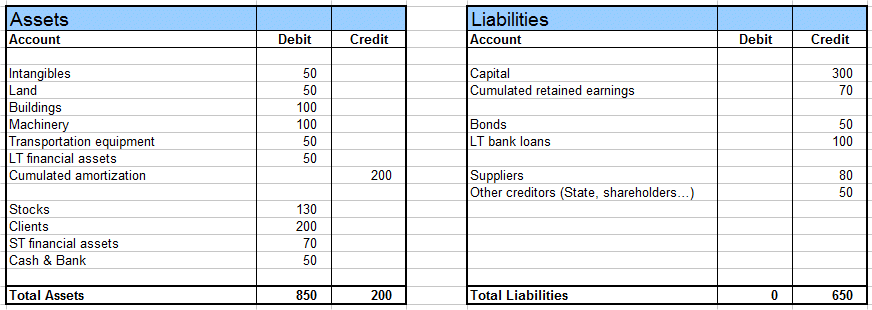
We shall explain is this lesson that the list of assets is fundamentally heterogeneous. It is more just a list, than a presentation of some intrinsic worth of the firm.
Let us distinguish three categories in the assets:
- the cash and the money at the bank, plus the short term financial assets, plus the client paper
- the stocks
- the fixed assets
Remember that all the assets are recorded in the BS at their acquisition cost.
For the cash & bank it is of course also the "market price".
And so it is, or just about, for the ST φ assets (read "short term financial assets"), because as we saw in the previous lesson they are very liquid.
For the client paper, the value recorded in the BS is also almost their market value. Good client paper can be sold at anytime with a small discount (taking into account the delay of payment of the client, and the risk of the client).
What is more usual with client paper is to use them as guarantee for short term loans. We shall see this in another course on finance.
The case of stocks.
Suppose, to make life simple, that as usual we consider a retail shop. The stocks are recorded at their wholesale value, not their end-market price.
The fundamental profit generation process of the shop is to buy at one price and to sell at a higher price.
The difference between the end-market (also called "retail") price of stocks and their acquisition cost for us covers:
- the charges to operate the shop
- the profit of the owners
The fixed assets are also recorded at their acquisition costs.
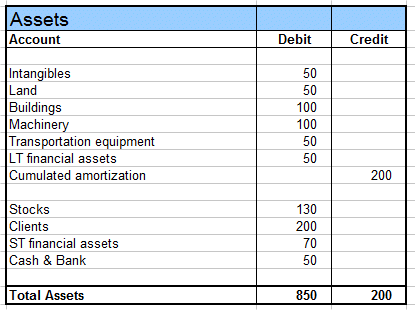
Usually we don't intend to sell any fixed asset, so it doesn't matter much but their market price today, in most cases, is not the value recorded in the BS.
This is particularly true of land.
The profit generation process of a firm is through sales.
There are two types of sales:
- the normal process of selling stock items at a higher price than their stock value
- exceptional sales of some other assets (mostly fixed assets)
As a rule in accounting, the profit is only recorded at the time of the sale, not before.
However, on the other hand, if there is a big potential loss in the assets, according to the prudence rule of accounting, we want to record it (via adjustments) as a charge during the cycle when it is observed.
The case of financial assets is special. If we keep a portfolio of financial assets (LT and ST) with the intention of making financial operations (buying and selling) the Generally Accepted Accounting Principles (GAAP) have specified procedures to "mark to market" the financial assets, that is, via adjustments, to constantly value, in the BS, these assets at their current market price.
But this idea - getting away from eight centuries of accounting principles - doesn't work well:
- market prices change all the time: so it entails a lot of accounting work
- market prices are not always easy to figure out
- the idea has been viewed as one of the causes of the worldwide subprime crisis of 2008-2009
The subprime crisis was simply created by American banks which sold loans to uncreditworthy people (based on the fact that their house would provide a good collateral guarantee). Then these loans were "securitized" (that is, bundled as packages of credits) and sold to banks all over the world.
The "mark-to-market" procedure precipitated some banks into bankruptcy when parts of their financial assets lost a lot of value, even though it was not a loss in the sense of for instance an irremediable fire, but just market fluctuations, and in some cases the assets regained value after the bankruptcy.
To summarize:
- assets in the BS are heterogeneous
- some are naturally at their market value
- some are naturally not (the stocks)
- the fixed assets are usually not at their current market value
- the idea of trying to change the recorded value of financial assets to reflect their current market value (the "mark-to-market" procedure) leads to more problems than improvements.
