


Video
We are reaching the final step of the beginning of accounting.
We saw the Trial balance. We adjusted it. And we extracted all the "Revenue" accounts to form the Income Statement.
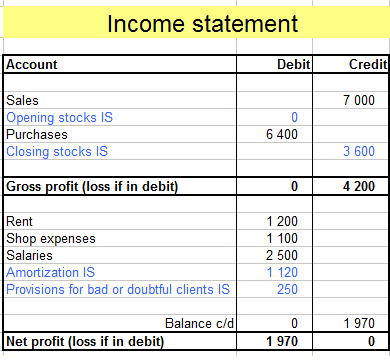
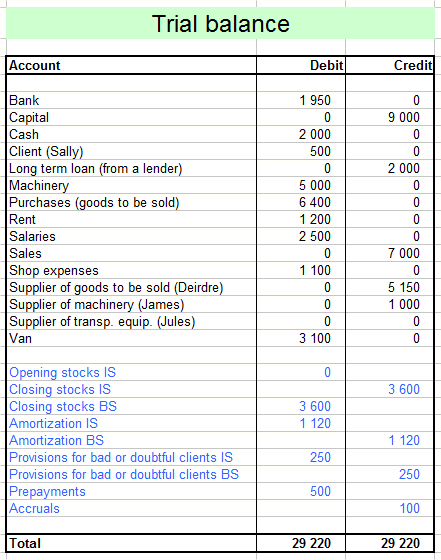
Now in this adjusted Trial balance we replace all the Revenue accounts with just one line: the bottom line of the IS.
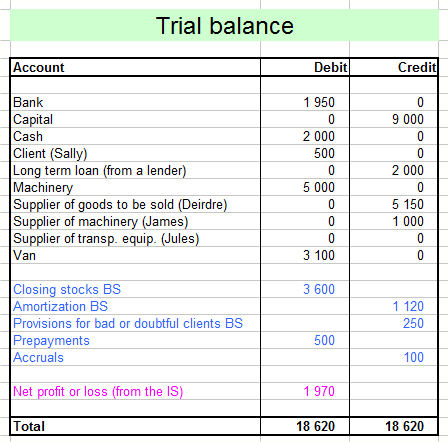
This document is the Balance Sheet.
It just needs to be rearranged into the usual presentation.
It is customary to present the Balance Sheet listing first all the assets (adjusted for amortizations and provisions) and then all the liabilities.
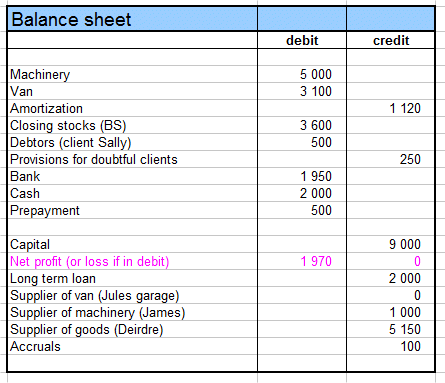
We shall comment on the liabilities ("Why capital is there?", "Why the profit or loss is there?") in a moment.
Usually the Balance Sheet is presented in two pages (or two tables), one for the Assets and the other for the Liabilities.
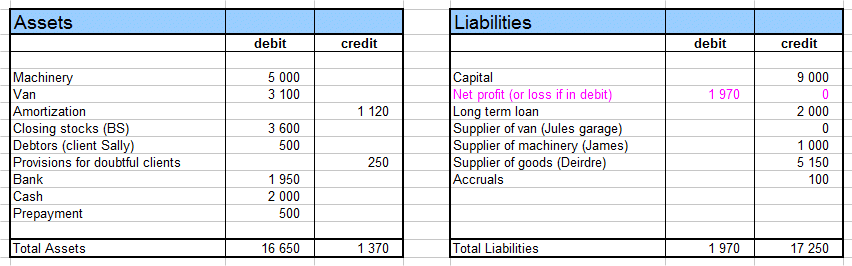
Notice that on the Asset side, the total debit minus the total credit = 15280€.
And on the Liability side, the total credit minus the total debit is also equal the 15280€.
It must always be so by construction.
Despite what we may read in some textbooks, it is not because of this equality that it is called the "balance sheet", but because it is a list of balances.
The IS and BS at the end of an accounting period are documents belonging to the accounting system. The accounting system is itself one of the various management information systems (MIS) to run the firm.
The IS and BS may be seen as the two most fundamental documents presenting synthetic information about the firm.
In our example, which does not purport to illustrate good management, the first accounting cycle ends up with a loss, though this is frequent.
The 1st year we need to tune the operations, and then grow them.
Accounting provides a "dashboard" of the firm.
- the IS shows Sales, Costs and P&L (Profit or Loss) of the accounting cycle
- the BS shows, at the end of the accounting cycle, what the firm owns (its assets) and what it owes (its liabilities)

accounting provides a dashboard of the firm
A word on the liability side of the BS:
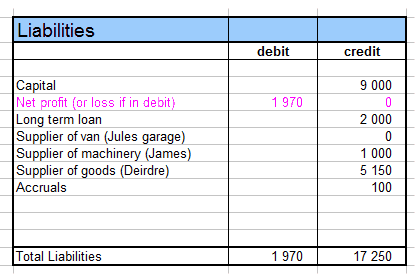
- the long term (LT) loan and the IOU's to suppliers are clearly liabilities
- the capital is viewed as a liability to the owners. Even though this sum is not due, it has a status comparable to money received from lenders
- and the profit or loss (P&L, usually written, curiously, with an "&" which means "and") is on the liability side too: to understand this, think it were a profit, in credit, it would indeed represent more value belonging to the owners.
Note: the profit of the accounting cycle is the increase of value of the assets resulting purely from operations (and not from injection of fresh money that would be recorded on the liability side). This increase in asset value has a counterpart automatically created by all the mechanics of accounting: it is the line shown in pink in the above BS liability side.
This double presence of profit in accounting is always a source of puzzlement for beginners: how come the profit can be at the same time "smeared all over the assets", and written on a specific line in the liabilities?
We saw the same "double presence" with the capital itself: on one hand, it is the money put into the firm, going firstly in the till, and then used up all over as the operations run; and on the other hand it is registered as coming from the shareholders in an account entitled "capital account".
Think of a bike resting against this wall: you see an asset. This bike has an owner, which would correspond to a liability side: but in general there is no tag attached to the bike saying to whom it belongs. Therefore we see an asset with our eyes, but a liability only with our mind.
We can see right away what would be the impact of higher sales on the IS and BS.
Suppose, instead of selling our goods at 100€ apiece, we sold them at 130€ apiece. Then the sales figure would be 9100€.
And suppose the charges corresponding to these sales did not change. Then the IS would become this:
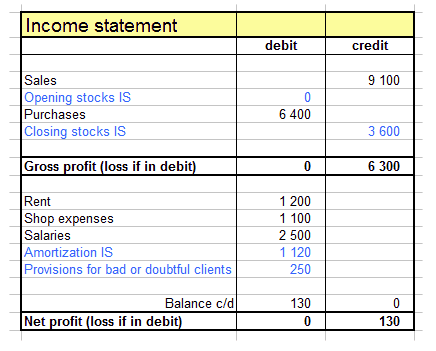
The accounting period would end up with a profit instead of a loss.
And if all the extra value coming in from sales went into client credit (= client paper = IOU from clients) the BS would look like this:
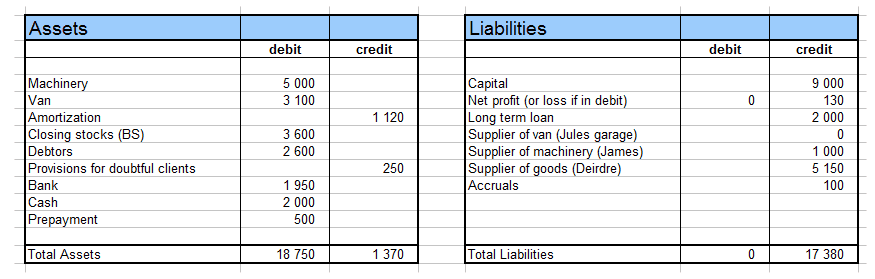
On the asset side, the Debtors account (= Client account = Receivables) would increase to 2600€, and on the liability side, the Net profit or loss would become a profit (i.e. a credit) of 130€.
Managing a firm is a long sequence of decisions taken by the managing team to allocate resources:
- money resources
- work resources
It is a sequence of choices.
Of course the human aspect is fundamental:
- management of the workforce (= managing "human resources"= HR)
- management of the relationships with
- clients (CRM = customer relationship management)
- suppliers
- bankers and other lenders
- authorities
Aside from this human aspect, managing a firm is as we said a series of choices. Choices about:
- which products to manufacture
- technology
- product technology
- production technology
- markets
- clients
- prices
- advertizing, marketing
- and many more...
To manage a firm is great fun!
When we make profits we feel very intelligent, and when we make losses we feel very unlucky :-)
