


Video
We've been working with the Trial balance for the past seven lessons, so we should begin to be familiar with it.
Here it is presented in the usual way, with the normal accounts first (in alphabetical order), then the adjustments.
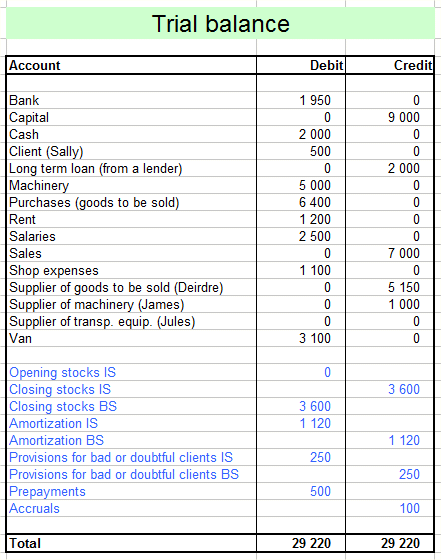
The attentive reader will note slight changes from the last balance of the preceding lesson.
Instead of directly crediting Sally account with the provision for bad or doubtful clients, we passed it in credit in a new account "Provision for bad or doubtfult clients BS".
The totals, both in debit and credit, as a consequence of this alternate way to record the provision, increased from 28 870 to 29 220.
We changed a bit the names of the accounts from past lessons, in order to have more usual names:
- "Sally account" became "Client account". In this example, it is also the "Debtor's account", because there are no other debtors.
- "James account" became "Supplier of machinery account". It is a part of the creditors.
- etc.
Aside from these minor transformations, it is the same trial balance which we reached at the end of the lessons on adjustements.
We saw 5 types of adjustments:
- Ajustment for inventories (= adjustment for stocks). There are two accounts: "Closing stocks IS" and "Closing stocks BS" receiving the two parts of the double-entry. And since we are in the first accounting cycle, I added an "Opening stocks IS" account with debit 0, because in future accounting cycles the Trial balances will always have with an "Opening stocks" account.
- Amortization. Two accounts: "Amortization IS" measuring a loss of value of our assets, even though no cash or money, or value, is exchanged with the ROW at the time of this recording (it was done in the past); and "Amortization BS" which is the other part of the double-entry.
- Provisions for bad or doubtful clients. Two accounts: "Provisions... IS" measuring a loss of value (or expected loss of value) of an IOU; and "Provisions... BS" which is the other side of the double-entry (I treated it here rather than directly in the "Client account").
- Prepayments. We see only the debit part in "Prepayments"; the credit part was taken care of directly in the "Shop expenses account".
- Accruals. Again we see only one part, the credit part, in the account "Accruals"; the debit part was taken care of directly in the "Shop expenses account".
If you don't feel at ease with these adjustments you should go back to the previous chapter and review them.
The Income Statement is a document presenting:
- The sales (= revenues = turnover)
- The costs (= chages = consumptions) matching the sales. In other words, we present in the IS only the costs which were actually incurred to produce the sales. Other possible charges, which do not correspond to the sales of the accounting cycle under study, are removed from the "Revenue accounts" via adjustments.
- the difference between sales and costs, which is the Profit or Loss (P&L) of the accounting cycle.
This document presents clearly the operations and their result for the accounting cycle, even though – like typographers of old days who could read mirror texts directly from plates – professional accountants can evaluate the performance of the firm by simply reading its trial balance.
Important point: the figures (sales, costs, and P&L) in the Income Statement are not necessarily cash.
This is one of the fundamental aspects of double-entry accounting invented eight centuries ago: double-entry accounting is an accounting of value, not just of cash.
By this, we mean that the sales figure in the IS doesn't necessarily correspond to a cash (or money) inflow into the firm. Sales on credit are also included into the revenues of the accounting period.
Same remark for the charges: we record them in the IS, whether we actually paid them with cash (or money at the bank) or with IOU's.
As a consequence, the Profit or Loss of the year doesn't necessarily correspond to a variation in cash or money we have in the firm. We may very well make a profit during the period, and yet have less cash at the end than at the beginning of the period.
It is because double-entry accounting is an accounting of value (of values of all sorts) that it has so many accounts. Each type of value has its own account. We need more than just the account for cash of for money at the bank).
The fellows running the pizzeria across the street from our offices tend to mix up cash in the till at the end of the day, and profit of the day. Every so often they go and gamble this cash at a casino nearby. And they are chronically on the verge of bankruptcy, even though their restaurant is a money making machine.
The last paragraph was written in 2010. Since then the pizzeria went belly up. A receiver liquidated the firm. It was sold for a fourth of its value (plus a kickback, but not to the original owners), then sold again.
Moral of the story: don't mix up value and cash.
To prepare the IS, we check the "Revenue accounts" in the adjusted TB:
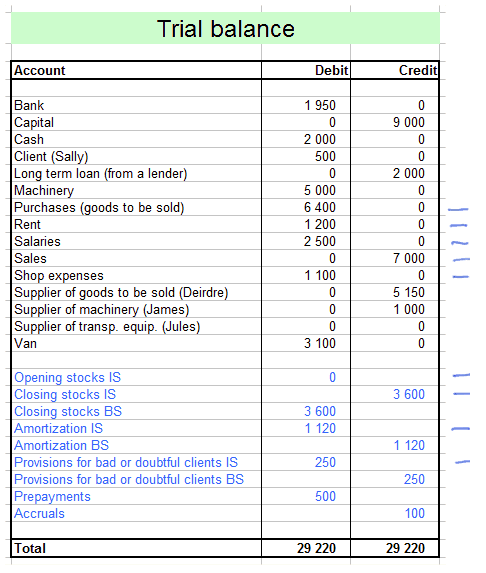
and we "extract" them to present them on a new sheet called the "Income Statement".
Income Statement:
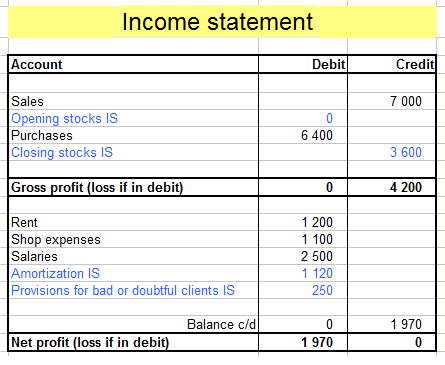
The top part, above the line "gross profit", is called the "Trading account". It computes the "gross profit" by subtracting the COGS from the sales.
The COGS are calculated with the formula:
COGS = Purchases - [Closing stocks - Opening stocks]
In this example, this yields 6400 - [3600 - 0] = 2800€. Whence a gross margin (= gross profit) of 7000 - 2800 = 4200€.
Then, below the "Gross profit" line, we have the so-called "operational charges":
- those in black are called "cash operational charges" (even though some of them can be paid with promises!)
- those in blue are called "non cash operational charges"
And we observe, in this example, a loss for the period of 1970€, since all the operational charges add up to 6170€, exceeding the gross margin which is only 4200€.
Next step, after the preparation of the IS, will be the preparation of the Balance Sheet.
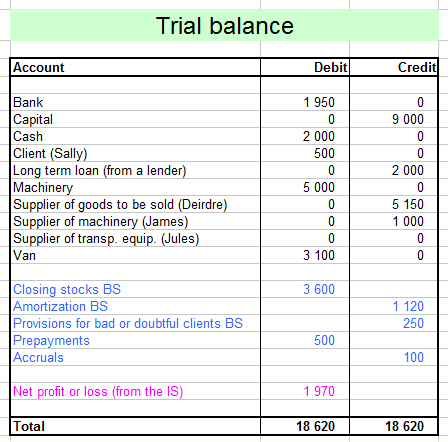
To do this, we shall simply replace all the "Revenue accounts" of the adjusted Trial balance by just one line: the balance of the Income Statement (= "bottom line" of the IS).
And, lo and behold: this is the Balance Sheet.
 |
|
It just needs some rearranging to be presented in the standard way, with an "asset side" and a "liability side".
This will be the subject of next lesson.
