


General accounting
I. 3. History of accounting
Video
Accounting is exactly as old as History for a very simple reason:
- Herodotus defined the beginning of History as the beginning of writing
- the first writings were accounting records
Let's consider a long historical perspective:
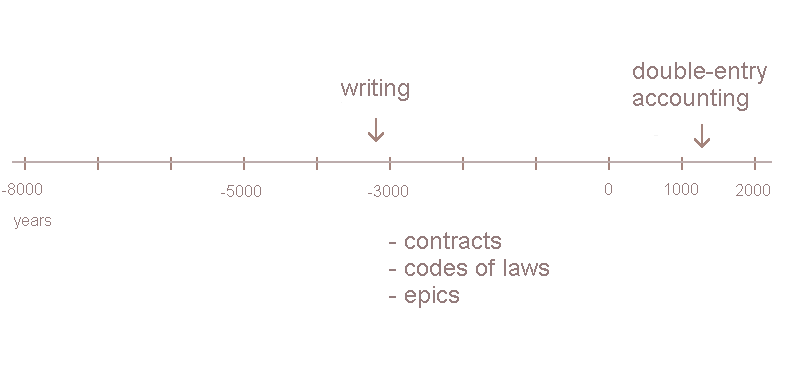
In the millennia before -8000, the Earth warmed up. It was the end of the last ice age. In parts of the Middle East and several other areas of the world, human beings changed their way of life. Instead of being wanderers hunting and gathering their food, they settled down, founded villages, and began to produce their food: growing crops and raising cattle.
This is also the beginning of a more sophisticated social organisation, of more elaborate exchanges, of codes, etc.
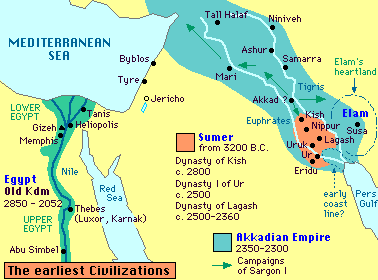
Some proto-writings have been identified in the millenniums between -8000 and -3000. It is around -3200 b.c., however, that the firt writings properly speaking, that is signs that could be read in a unique way to tell something, appeared. This took place in an area of the Middle East that was called Sumer (somewhat north of modern Koweit).
To go further: notice that the concept of uniquely interpretable signs is more fuzzy than it seems, particularly in poetry, and most particularly in Chinese poetry which uses loosely linked ideograms. Therefore to say that the signs written on clay balls in Sumer in 3200 bc were writings, and that pictures on rocks or cave walls in 20 000 bc were not, is disputable. See: poetry of Li Po.
These writings were used to record contracts between people who had exchanged some things. They also served to note legal codes (Hammurabi code, -1750), and epics (Epic of Gilgamesh, late third millennium and second millennium).
From -3200 b.c. until the XIIIth century a.d., accounting techniques were rudimentary. They essentially consisted in recording how much money we had.
There are indeed two types of accounting:
- single-entry accounting
- from -3200 to the XIIIth century
- it is also called cash accounting
- it is the one we still use in our personal checkbook booklet
- double-entry accounting
- invented by Italian merchants in the XIIIth and XIVth centuries
- more sophisticated than single-entry accounting
- we shall see that it is a value accounting
- it records transactions, with a debit in some account and a credit in some other account
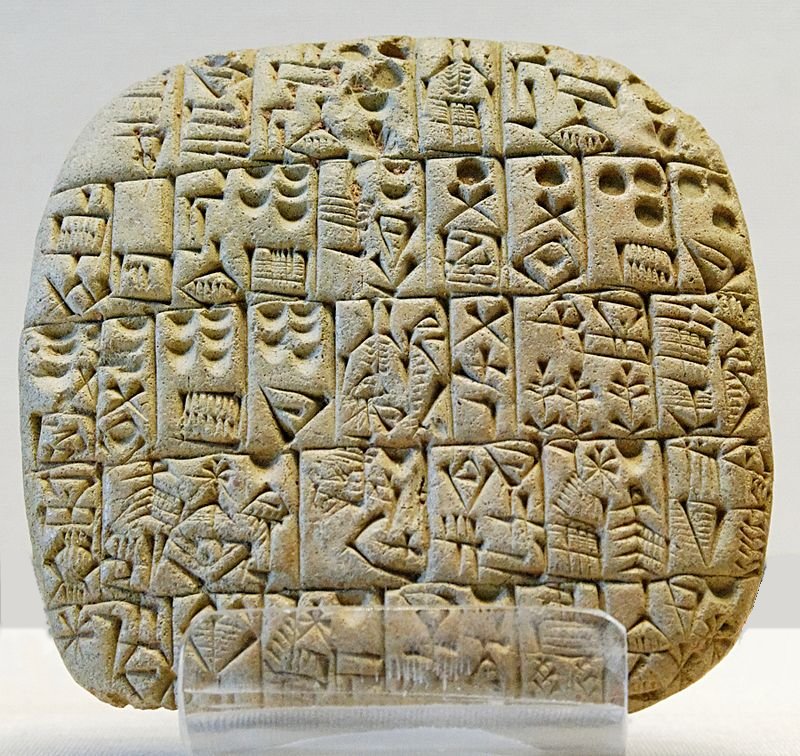
Contract for the sale of a field and a house, Shuruppak, c. 2600 bc. Musée du Louvre.
But where are debits and credits!!?
When we begin to learn double-entry accounting, the technique of recording movements of value into two accounts is a bit confusing at first, and takes a little while to be mastered. But once we understand how it works, its simplicity and power appear, and we wonder how we could for so long do otherwise.
Double-entry accounting is also called nowadays simply: general accounting
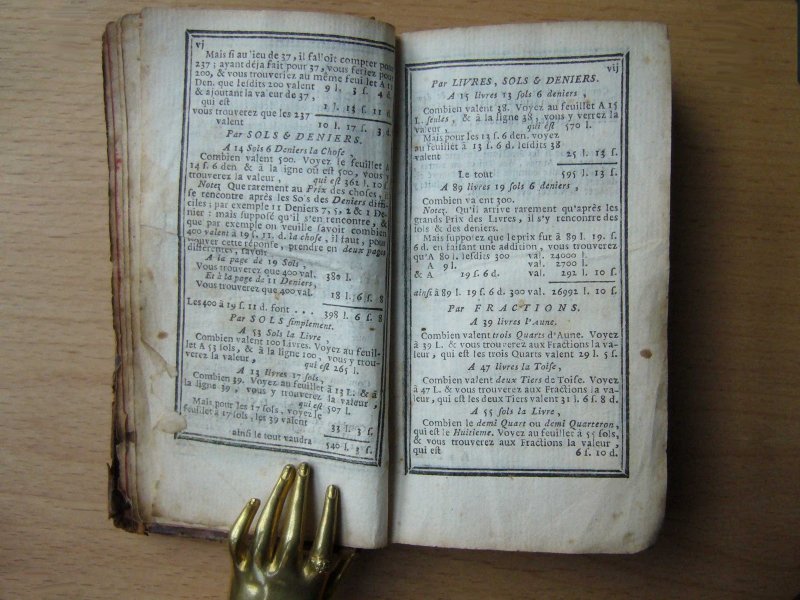
The Book of Completed-Accounts
by François-Bertrand Barrême (Tarascon, 1638 - Paris, 1703)
published in M.DCC.LXVIII. (= 1768) by l'Imprimerie de Didot
Source : blog "Au fil de Lau"
Landmarks in double-entry accounting:
- XIIIth century: emergence of the techniques of double-entry accounting in Northern Italy
- 1494: first "textbook" by Luca Pacioli
- 1543: book of Jan Ympyn. He is the author who popularised double-entry accounting all over Europe
- 1682: book of Bertrand-François Barrême (which was used for a couple of centuries in France, and gave the word "barème": abacus, table, scale)
