


General accounting
V. 19. The need for adjustments in the Trial balance
Video
We reached the Trial balance and we marked off Revenue accounts and Capital accounts
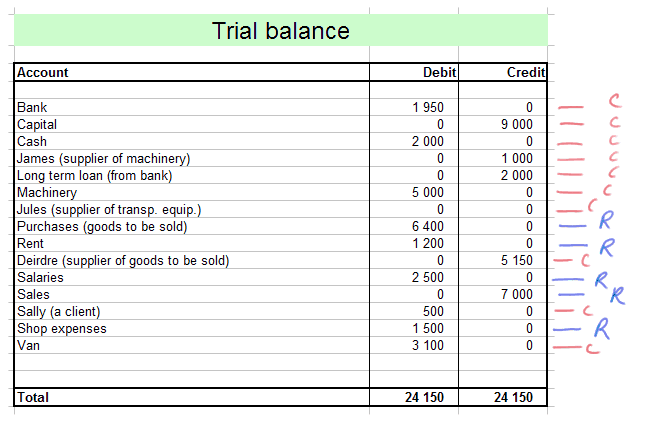
The Revenue accounts are the Sales and the various charges of the accounting period. Altogether they will form the Income Statement.
Let's see what would we get if we tried to prepare right away the Income Statement.
We would take ("extract") the Sales and the various charges from the TB and present them on a document like this:
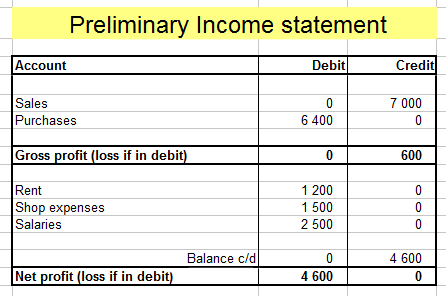
So we would see Sales of 7000€ (= 70 items sold at 100€ apiece) and charges (= consumptions of the period) altogether of 11600€.
We would therefore observe a loss of 4600€.
But this is incorrect on several counts:
- The Purchases of 6400€ correspond to 160 items purchased (at 40€ apiece). But we only sold 70 of them. So the real Cost of Goods Sold is 70 items x 40€ per item = 2800€
- We are missing some other charges which do not appear in the TB
A closer look at the purchases and the cost of goods sold (COGS):
To check the real cost of goods sold, we can go back to the page of the mini accounting system which presents the journal, and also next to it the evolution of purchases, sales and inventory of items.
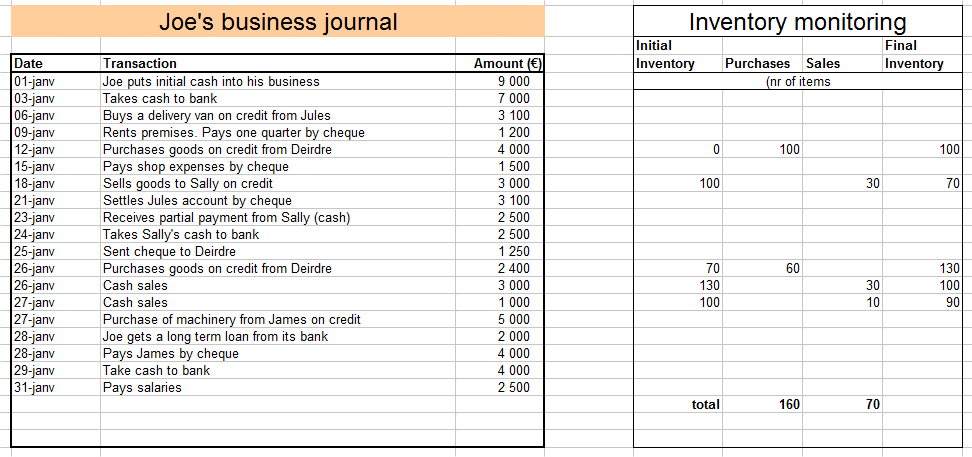
We purchased 160 items and sold 70 of them.
So the cost of goods sold is 70 x 40 = 2800€.
And the remaining 90 unsold items (worth 3600€ at purchasing price) must be accounted for in an inventory account to be opened.
The sum of 2800€ + 3600€ is naturally 6400€, that is the amount of purchases during the accounting cycle.
Secondly, there are consumptions which do not appear in the "raw" Trial balance:
Consider the van, which we acquired for 3100€. It won't last forever. Every year it loses some of its value.
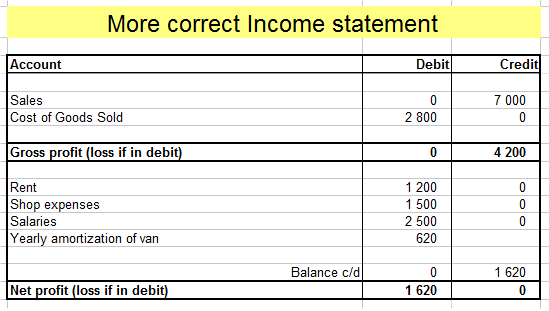
Suppose it loses all of its value over 5 years. Then, in truth, each year we also consume 620€ of the value of the van.
Erratum in the video: we changed a bit the journal, from the first lessons, and actually we bought the van for 3100€ (see journal above). So a "linear amortization" over 5 years is a charge of 620€ per year.
A more correct Income Statement will take into account the actual COGS and not all the Purchases. And it will count the loss of value of the van during the year.
There will be some more adjustments:
- amortization of the machinery
- (possible) provision for doubtful clients
- (possible) prepayment: a charge which "overlaps" this year and next year consumptions
- (possible) accrual: a consumption for which we haven't received an invoice yet, and therefore is not in the TB
In this lesson, we explained the ideas behind the adjustments.
In the next lessons, we shall study the actual techniques, using double-entry accounting, to make these adjustments.
