Esc-Clermont Sup de Co
2nd
years, 1st semester
Course:
Corporate finance
Teacher:
André Cabannes
Please write your
name in this box:
Final exam
December, 2005
3 hours, 20 questions, each worth 5 points.
Write your answers on this document in the blank space below each question.
Question
1: The firm F sells
computers. The firm G sells flowers. F sells a computer to G for 2000€, on
credit. Let’s look at this transaction from F point of view: what are the two
entries made for this transaction in F accounting system ?
Credit
the sales account 2000€
Debit
the debtors account 2000€
Now, let’s
look at this transaction from G point of view: what are the two entries made in
G accounting system ?
Credit
the suppliers account 2000€
Debit
the fixed assets (computers) account 2000€
Question
2: Is the asset
side of the balance sheet of a firm the list of all the values today of what the firm owns? (Hint: Make
comments on the Historical costs rule.)
No.
The asset side of the balance sheet of a firm lists all the assets the firm
owns, recorded at the historical cost. Typically, land acquired a long ago is
usually undervalued.
Question
3: Why the credit
and debit columns of a trial balance should add up to the same number?
Because, each transaction leads to an entry on the
debit side of an account, and to another entry with the same value on the
credit side of another account. So, globally, along the year, the debit entries
and credit entries remain always equal, and so are their balances.
If they add
up to the same number, does this prove that the trial balance is necessarily correct ?
No.
There are mistakes which do not create imbalances ;
for instance, to reverse a debit entry and a credit entry.
Question
4: A firm sells for 120€, cash, an item recorded
at 90€ in its stocks : show the impact of this
operation on the balance sheet.
The
stocks account will decrease by 90€. The cash account will increase by 120€.
And, on the liability side, the profit account will increase by 30€.
Can a firm
sell something at a lower price than its purchasing cost ?
(Discuss.)
Yes.
It will result in a loss, for this operation. (In some economic sectors, it is,
in theory, forbidden.)
Consider
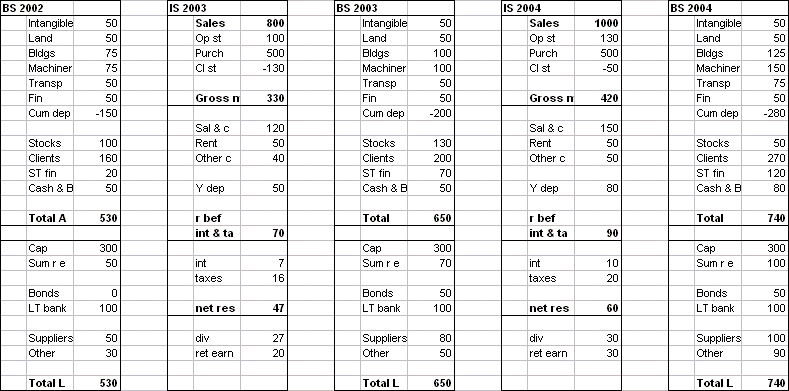
the following year end documents of a firm. Questions 5 to 8 refer to these
data.
Question
5: What are the Net
Fixed Assets at the end of 2002, 2003, and 2004 ?
End
of 2002: 200
End
of 2003: 200
End
of 2004: 220
Assuming
that the firm did not sell or otherwise remove any fixed assets from its
balance sheets, what were the investments in fixed assets in 2003 and 2004?
2003:
50
2004:
100
Question
6: What is the ROCE
ratio in 2003 and in 2004?
ROCE = result before interest
charges and taxes / capital employed (or averaged capital employed)
Using
simply end of year capital employed,
ROCE
2003 = 70 / 520 = 13,5%
ROCE
2004 = 90 / 550 = 16,4%
Question
7: What do we mean
by “this firm doesn’t use much its free financing possibilities” ?
The
free financing of a firm is (approximately) represented by its current
liabilities, i.e. those liabilities which do not cost anything in terms of
financial charges. In the example above, the current liabilities are much lower
that the current assets. The liquidity ratios of the firm are very high.
Presumably, the firm could obtain more credit from its suppliers and other
“free” creditors.
Question
8: Prepare the Cash
Flow statement of the firm for the year 2004.
Cash flow in: 930
Sales
= 1000
Minus
increase in debtors = – 70
Cash flow out: 900
Purchases
= 500
Cash
operating expenses = 250
LT
Investments = 100
Taxes
& Dividends = 50
Minus
increase in suppliers and other creditors = – 60
Interest
charges = 10
Increase
in short term securities = 50
So,
the net variation in cash is + 30.
Question
9: What
distinguishes General Accounting and Cost Accounting ?
General accounting (IS & BS)
•
Gives a very general view of the firm
•
Legally required, and the year end docs must be published
•
Turned toward the
past
•
Too global to be useful to manage the firm
•
Comes late
Cost
accounting (Sales per product lines and costs in every « cost centers)
•
Useful to manage the firm
•
Turned toward the
future
•
Very detailed
•
More or less in real time
What is a
cost center? What is a profit center?
A
cost center is any small subdivision (physical or
logical) of the firm where costs are generated.
A
profit center is a subdivision of the firm to which
we can associate not only costs but also sales, and therefore a (partial or
complete) income statement.
Question
10: Why complete
unit costs are artificial ?
Because
they require “allocation keys”, to allocate fixed costs, to be computed, and
they depend upon all the activities of the firm.
For
instance, a workshop manufacturing 10 000 chairs per year, will have a
complete unit cost per chair that depends on whether it also makes other pieces
of furniture.
Question
11: Consider a
security S which can be purchased today. In one year, it will have a value X
which is random (depending upon the state of the economy). The possible values
of X, with their respective probabilities, are given in the following table :
|
Possible outcomes |
80 € |
90 € |
100 € |
110 € |
120 € |
130 € |
|
Probabilities |
10% |
15% |
25% |
25% |
15% |
10% |
If a money
management fund purchases S today, for a price P, how will it record this transaction
in its accounting system? (Debit and Credit.)
It
will credit its cash or bank account with a value P. And it will debit a
financial assets account with the same value P.
Question
12: What is the expected
value of S in one year? (Explain your calculations.)
E(X)
= 105€
It
is the weighted average of the possible outcomes of X.
What is the
standard deviation of the value of S in one year? (Explain your calculations.)
Std
dev (X) = 14,3€
It
is the square root of the variance of X. And the variance of X is the weighted
average of the possible squared deviations of X around its mean.
Question
13: In the euro
zone, in November 2005, what was the rate of return of a risk free security?
2%
What is the
price today (at the date of preparation of this exam, in mid-November 2005) of
a risk free security that will be worth 105€ in one year ?
105€
/ 1,02 =
102,94€
Is S (of
question 11) risk free?
No.
Its value next year has variability.
Question
14: Suppose S sells
today for a price P = 92€. What is the expected profitability of S?
rS = (105 – 92) / 92 =
14,1%
Position S
on the risk return graph?
We
must compute the risk of S, defined as the std dev of its profitability
: it is 15,6%
Question
15: Suppose we have
920€ to invest. We want to invest this sum into a “portfolio” constructed as follows : half of our money is invested into safe treasury
bills and half into S. What is the expected value of our portfolio in one year ?
Answer:
469,2€ + 524,9€ = 994,1€
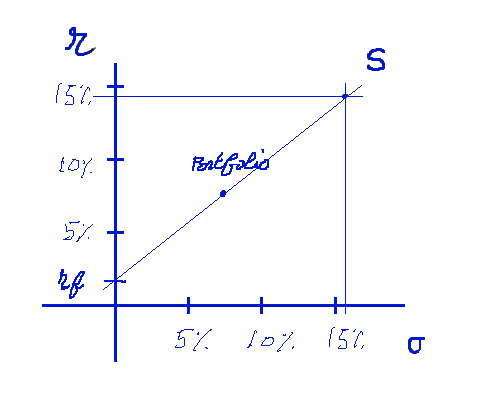
Position
our portfolio on the risk return graph.
Question
16: Explain the
concept of present value. Use the following example :
why a sum of 100€ promised in one year is not worth 100€ today ? What happens
to its present value if its future value is risky?
A
promise for 100€ in one year is not cash today. Therefore we cannot use it as
cash to make an investment, and earn money with our investment. Therefore, if
we buy this promise today, we “give up” the possibility to have our own money
work. So, we should buy this promise for less than 100€.
If
the promise is risky, its price today is even less than if it is not risky.
The
present value of a future cash flow is the maximum cash amount that we would be
willing to pay today, to acquire the promise to receive the cash flow in the
future.
Question
17: We are
considering making an investment I, which will produce the following cash flows
in the future for us :
|
(mio euros) |
year 0 |
year 1 |
year 2 |
year 3 |
year 4 |
|
|
|
|
|
|
|
|
Future
cash flows |
|
50 |
100 |
130 |
80 |
Suppose
this investment has the same risk pattern as S above, i.e. its opportunity cost
of capital is r = 14,1%. What is the Present value of
the stream of future cash flows of I? (Show your
calculations.)
Answer:
255,35 mio euros.
|
Discount
rate |
14,1% |
|
|
|
|
|
|
|
|
|
|
|
|
(mio euros) |
year 0 |
year 1 |
year 2 |
year 3 |
year 4 |
|
Future
cash flows |
|
50 |
100 |
130 |
80 |
|
PV of future cash flows |
|
43,82 |
76,81 |
87,52 |
47,20 |
|
Sum of PV |
255,35 |
|
|
|
|
If we can
make this investment with an initial cash-flow-out of 200 millions euros to be
spent year 0, is it a good investment?
Yes,
because 200 is less than 255,35, and therefore the Net
Present Value of the investment is positive.
Question
18: Explain what we
mean by the IRR of an investment.
If
the initial cash flow to be invested (here 200 mio
euros) is already known, it is the value of the discount rate which makes the
NPV equal to zero.
Suppose we
can make I with CF year 0 = 200 mio
euros. What is the NPV of I, if the proper discount
rate (i.e. the opportunity cost of capital) is 20%?
224,9 mio euros – 200 mio euros = 24,9 mio.
What is the
NPV if r = 30% ?
184,8 mio euros – 200 mio euros
Estimate
the IRR of I.
A
geometric interpolation yields around 26%.
Question
19: What is one of
the central ideas introduced by Finance which distinguishes it from Accounting?
The
present value of future money is less than its face value.
Question
20: Suppose we want
to buy 100% of a firm, which already exists and already has a few past income
statements and balance sheets, from its shareholders. Why the “value of the
firm” to the shareholders (and therefore the minimum price we will have to pay
them) may be more than the total equity shown in the balance sheet (total
assets minus liabilities to external agents)?
For
the owners of the firm, i.e. the people owning its shares of capital, the value
of these shares is the money they will generate for them in the future,
properly discounted. It is not directly related to the balance sheet, which
records the value of the assets and liabilities of the firm today.