Esc-Clermont Sup de Co
2nd
years, 1st semester
Course:
Corporate finance
Teacher:
André Cabannes
Write your name in
this box:
Final exam
December, 2008
20 questions, each worth 5 points. Write your answers on this document in the blank space below each
question.
Question
1: Your firm has,
in its balance sheet, some fixed asset the net value of which is 100 (raw value
600 and cumulated depreciation 500). You sell this asset for 150 in cash.
Explain the impact of this transaction on the asset side and the liability side
of you balance sheet.
FA decrease by 100
Cash increases by 150
Total assets increase by 50
Retained profit increases by 50
Total liabilities increase by 50
Question
2: At the beginning
of the year, the inventories were 230. During the year, the purchases were 550.
And at the end of the year, the inventories were 180. What was the cost of
goods sold?
600
Question
3: Explain what is a “non cash yearly expenditure”. Why are they important to
get an accurate view of the result of the year?
It
is a decrease, during the accounting period, of the
value of some of the assets of the firm. Typically it is the “wearing out” of
Fixed Assets. It can also be provisions for bad client paper. It does not
correspond to any cash outlay, but it must be recorded in the IS as an
expenditure. It is a non cash expenditure.
Remember
that double-entry accounting is a “value accounting” system, as opposed to
single-entry accounting which is only concerned with cash.
Question
4: The ROCE is defined
as
[net result + interest
charges + income taxes] / [average capital employed]
while the
ROE is defined as
[net result] /
[average net worth]
Consider
the following year end documents
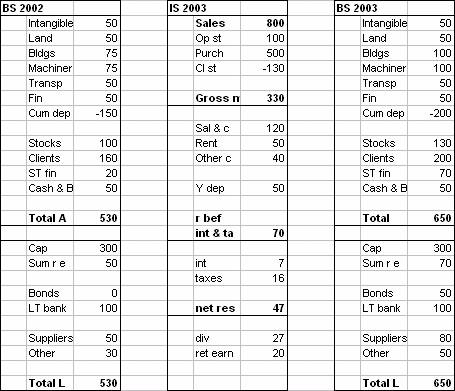
What is the
ROCE? And what is the ROE?
ROCE
= 70 / [ ( 520 + 450 ) / 2 ] = 14,4%
ROE = 47 / [ ( 370 +
350 ) / 2 ] = 13,1%
Question
5: Explain what we
mean by “the ROCE measures the performance of the firm, disregarding its
capital structure”.
The
ROCE looks at the value generated from operations (before interest and taxes)
by the capital employed.
Whether
the structure of the capital employed is made of much capital and little debt,
or on the contrary of much debt and little capital (i.e. a
high debt leverage), does not change the total capital employed. And on
the numerator side, the result before interest and taxes is not affected by the
structure of the capital employed either, because only financial charges and
therefore taxes change.
So
the ROCE is indeed a measure of the value generation capacity of the capital
employed disregarding how they are constructed.
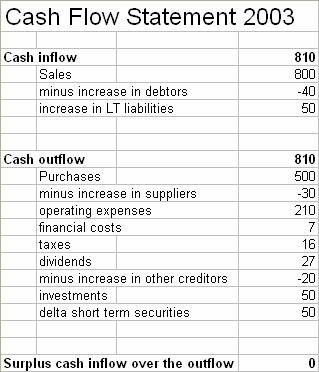
Question
6: Establish the
cash flow statement of the firm the year documents of which are given above in
question 4.
See
course notes lesson 4a
Question 7: You have in your pocket today (date
t) a security promising to pay you a certain sum X in the future at date T,
signed by the issuer. What are the three factors affecting the value of this
security today?
The
face value X (the sum written on the security)
The
length of time (T – t)
The
creditworthiness of the issuer (i.e. the risk that he does not pay you)
Question
8: What are the
main concepts added by Finance onto Accounting?
The
role of time, and the role of risk.
Why does
the Modern Theory of Finance make use of probability theory?
There
are circumstances when the future payments we expect are not sure figures but
figures which may vary. We then use the modelling framework of probability
theory to represent this variable situation: the future sum we shall receive will
be the outcome of a random variable in the experiment “wait until payment”.
Question
9: We can buy
today, in the stock market, a security S for a price PS = 35 euros.
We know, from a study of the past behaviour of S, that its value in one year
will be a random value X, with the following characteristics:
|
Possible future value (in euros) |
25 |
30 |
35 |
40 |
45 |
50 |
55 |
|
|
|
|
|
|
|
|
|
|
Probability |
5% |
10% |
15% |
40% |
15% |
10% |
5% |
What is the
expected value of X? (show your calculations)
Compute
the weighted average of the possible values with their probabilities as
weights.
(25
x 5% )+ (30 x 10%) + … + (55 x 5%) =
40 euros
You
may also notice that the calculations being “symmetrical around 40” (in the
sense that the same weights are put on pairs of figures, each pair averaging
40), this central figure of 40 must be the result, because all the weights add
up to 1.
Question
10: What is the
expected profitability of S?
The
profitability of S is defined as RS = (X – P) / P
RS
is a random variable.
E(RS) = (40 – 35) / 35 = 14,3%
Question
11: What is the
standard deviation of X? And what is the risk of S?
The
standard deviation of a random variable is the expected value of the squared
deviation of the random variable around its mean.
Standard
deviation of X = sX = 7,07 euros
The
risk of S is defined as the standard deviation of RS
It
is 7,07 / 35 = 20,2%
Question
12: There is
available in the stock market a security T for a price PT. The value
of T in one year will be a random value Y, with the following characteristics:
|
Possible future value |
75 |
90 |
105 |
120 |
135 |
150 |
165 |
|
|
|
|
|
|
|
|
|
|
Probability |
2% |
6% |
18% |
48% |
18% |
6% |
2% |
Is T more
or less risky than S?
We
compute E(Y) and sY.
E(Y)
= 120 euros
sY = 16,43 euros
Then
we observe that Y is relatively less variable around it mean than is X
sY / E(Y) = 0,137 while
sX / E(X) = 0,177
so T is less risky than S.
What can we
already say about the price of T?
Since
T is less risky than S, T will have less profitability than S.
The
profitability of S is (40 – 35)/35, which is also (120 – 105)/105.
So
T has to be worth more than 105 euros on a rational market with no arbitrage
possibilities.
Question
13: We are
considering making the following physical investment in our firm
|
year |
0 |
1 |
2 |
3 |
|
|
|
|
|
|
|
CF
(millions of euros) |
-80 |
40 |
40 |
40 |
What are
the two fundamental rates attached to this investment?
The
opportunity cost of capital
The
IRR
Question
14: Suppose that this investment belongs to the same class of risk as the
security S of question 9 above. Is this investment worth making? (show your calculations)
If
this investment belongs to the same class of risk as the security S, then its
opportunity cost of capital is the expected profitability of S, that is 14,286%
(if we want to be – overly – precise).
Then
the PV of the first cash flow in one year is 35 million euros.
The
PV of the second cash flow in two years is 30,63
million euros.
And
the PV of the third cash flow in three years is 26,80 millon euros.
In
other words, the three cash flows we expect to receive are worth today 92,42 million euros.
If
we can create this project for 80 million euros, it is a good deal.
Question
15: What is the IRR
of the investment of question 13?
We
know that the IRR must be more than 14,3%
We
try calculations with 20%, and we still a positive NPV of 4,3
million euros.
The
we try a discounting rate of 25%, and we get NPV = -1,92
million euros.
Then
we may do a linear interpolation between 20% and 25%,
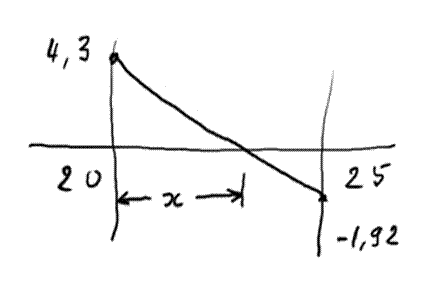
x satisfies the equation
x / 4,3 = ( 5 –
x ) / 1,92
this yields x = 3,46
and therefore an approximate IRR of 23,46%
The
exact result is 23,37%
Question
16: We have a big
firm making some widgets. We are considering buying 100% of another firm, which
will help us produce more widgets more efficiently.
Why the standalone cash flows of the projected acquisition are not what is
important to us in evaluating the price we should be willing to pay?
If
we buy the entire firm and it will help us produce widget more efficiently, the
new firm will change (for the better) our cash flows,
independently of the standalone cash flows of the new firm.
It
is like the key to a treasure trunk (like Skype was
for eBay). Then the standalone cash flows of the new firm are irrelevant. What
matters is what extra cash flows it will release for us.
Question
17: We buy today
for $1000 a 5year 6% bond (of the most basic type, paying yearly coupons). What
is the series of cash flows we are expecting in the future?
|
year |
1 |
2 |
3 |
4 |
5 |
|
|
|
|
|
|
|
|
cash flow |
60 |
60 |
60 |
60 |
1060 |
Question
18: Two years have
passed (and we have pocketed two coupon payments), and now we want to sell this
bond. The current rate for 3year bonds with the same ratings is 4%. What is the
value of our bond in the secondary market?
|
new discount rate |
|
|
|
|
|
4% |
0 |
1 |
2 |
3 |
|
|
|
|
|
|
|
cash flows |
|
60 |
60 |
1060 |
|
|
|
|
|
|
|
yearly PV |
|
57,6923 |
55,4734 |
942,336 |
|
|
|
|
|
|
|
total PV |
1055,501821 |
|
|
|
Our
second hand bond is worth 1055,5 dollars.
Question
19: What is a junk
bond?
It
is a bond with a very high risk of failure of the issuer, but also a very high
expected profitability (even taking into account the risk of the issuer).
Question
20: Suggest another
way than probability theory to assign present values to promises of future
payments. (Any suggestion will be worth a few points. Thoughtful suggestions
will be worth 5 points.)